
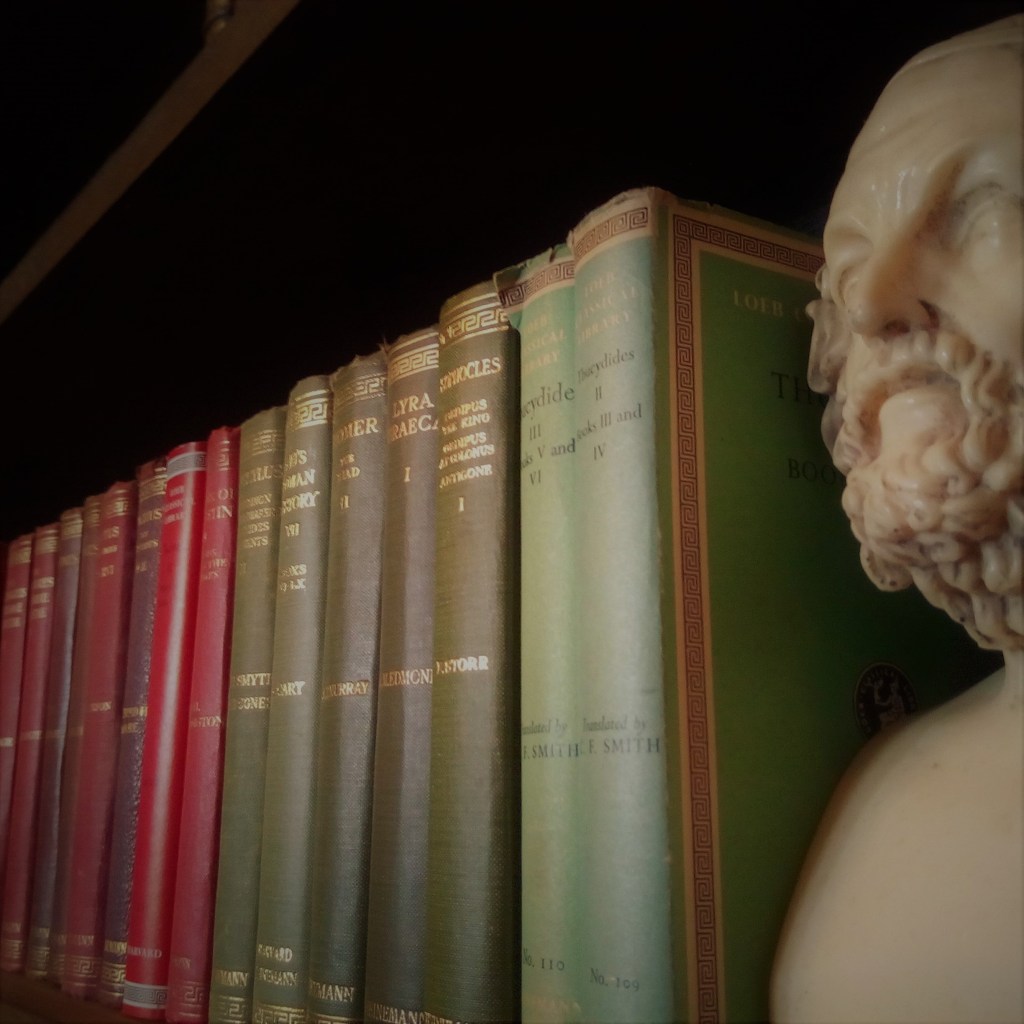
This week I’ve been buying Loebs.
Yes, it’s true that through the Open University I have access to the Digital Loeb Classical Library, which is huge and fabulous and indispensable – and, as anyone who’s used it knows, profoundly unsatisfying. It’s a nightmare to navigate – and frankly, it’s just not the same as having that little book in your hand. Certainly it’s better than nothing; but it’s not a patch on the Real Thing.
A long time ago – when I was at school, in fact – I made a resolution. Every time I saw a Loeb cheap in a second-hand bookshop I would buy it, no matter how broke I was or how uninterested in the author. This resolution extended to my family, who were under strict instructions never to leave a Loeb behind. The result is a collection of over 30 Loebs, in various states of tatteredness, very few of which have been bought new.
I love my Loebs. Even the broken ones.
I bought one online this week for the princely sum of £7.50, and when it arrived I was delighted to find that it had been previously owned – and signed – by eminent Latinist Nicholas Horsfall, who passed away last year.
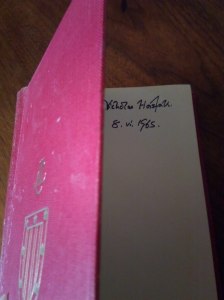
I love the way that second-hand Loebs have a personal history. I suppose that, because they were always fairly affordable, people weren’t averse to writing in them. So I know, for instance, that my 1914 set of Suetonius Loebs was owned initially by Fenton Macpherson, a journalist and writer who achieved success in the 1920s; and the set was later acquired by Professor Donald Earl of Hull University, who (according to his obituary) was ‘the opposite of politically correct’, and who was an enthusiastic early supporter of teaching classical literature in translation. I’ve spent many a happy hour pointlessly digging up the history of my Loebs.
I’ve also – as part of the award that I mentioned last week – put in an order for a pile of Loebs, which are currently (I hope) winging their way in my direction. This has, as you can imagine, required me to move lots of other books in order to expand my Loeb-shelf, and those other books are now in boxes piled up in corners. The needs of the Loebs outweigh the needs of the scraggy paperbacks.
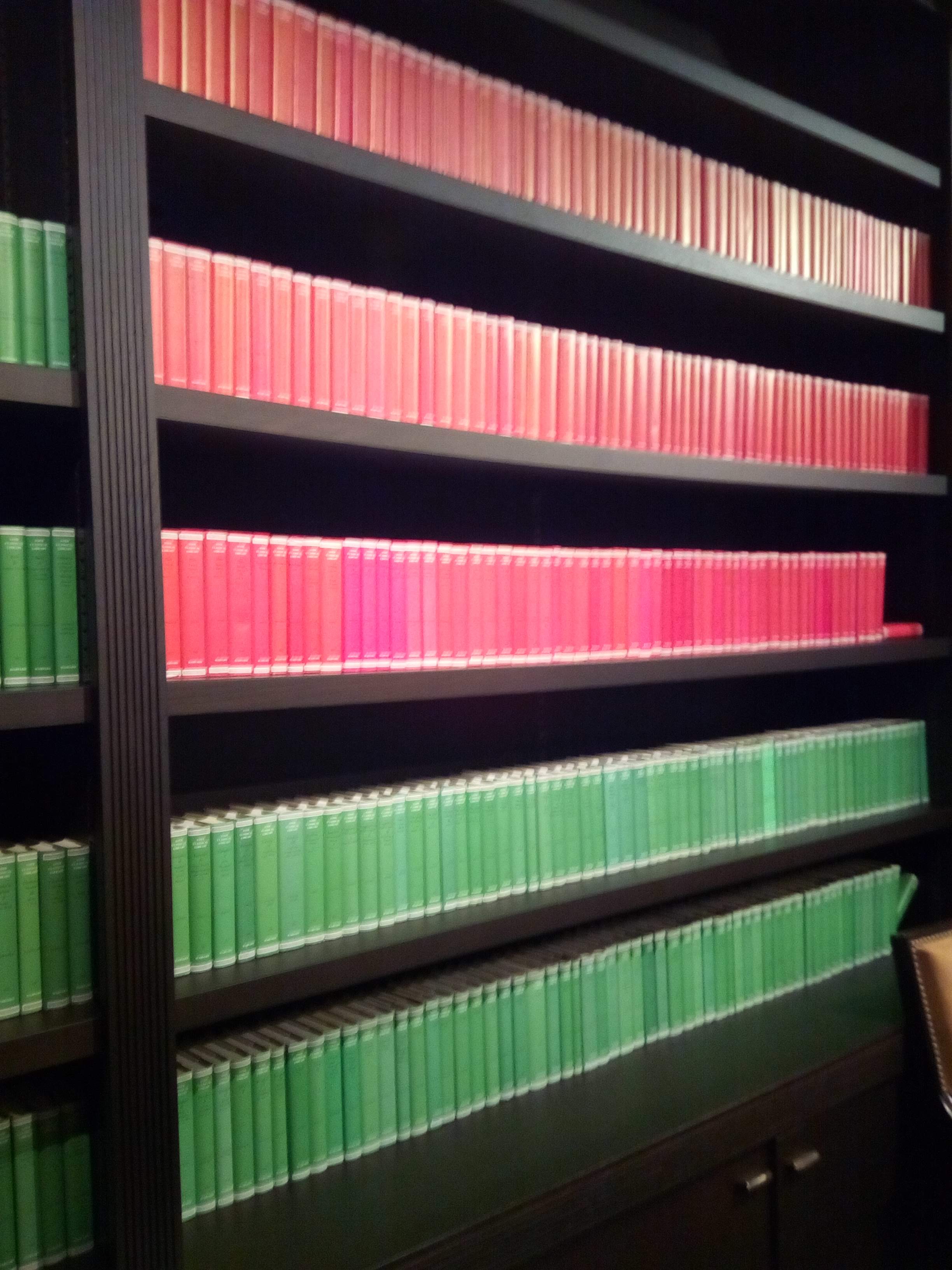
I have a very long way to go before I can match the collection on display at Kallos Gallery in London, sadly – but I’m working on it!
I was also reading up on the history of the Loeb Classical Library, just for fun. It’s interesting that the purpose of James Loeb, the founder of the Library, was to make Greek and Latin literature accessible to a wider range of people. Nothing really changes, does it? We’re still fighting that same fight, with our websites and our podcasts and our outreach. But I have to say that James Loeb did it better, for one simple reason: he decided to produce ‘handy books of a size that would fit in a gentleman’s pocket’. That was a stroke of absolute genius. I wonder how much of the Loebs’ success was due to their pocket-sized cuteness. Maybe I’m just superficial – but for years I’ve been choosing my coats based on whether they have Loeb-capacity pockets.
He was a practical chap, James Loeb, it seems. He wrote,
In an age when the Humanities are being neglected more perhaps than at any time since the Middle Ages, and when men’s minds are turning more than ever before to the practical and the material, it does not suffice to make pleas, however eloquent and convincing, for the safeguarding and further enjoyment of our greatest heritage from the past. Means must be found to place these treasures within the reach of all who care for the finer things of life.
I like this. It’s every bit as applicable to our own time, and it’s sound common sense. Talk only goes so far: sometimes more practical steps need to be taken.
Something else James Loeb said struck me. He said that he wanted a Loeb translation to be ‘a thing to be read for the pure joy of it’. I think this is one of the things I’ve been groping towards with my Comfort Classics series. In the discipline of Classics we (rightly) do a lot of critical thinking; we deconstruct and analyse and contextualise. That’s important and necessary work. But personally I would hate to lose that ‘pure joy’ of reading the texts, whether in the original language or in translation, or in some slightly guilty combination of the two.
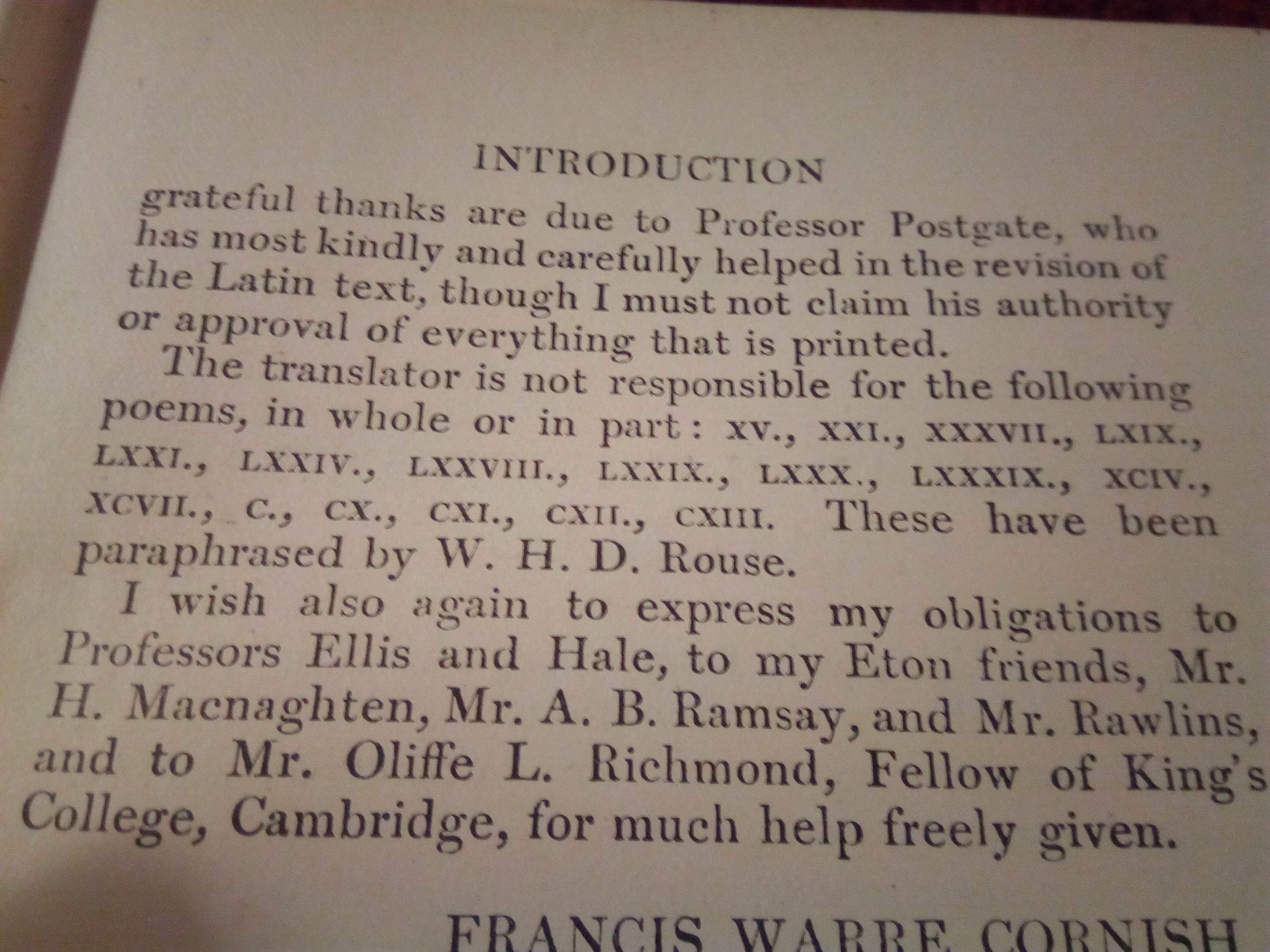
Reading about the history of Loebs also prompted me to take a better look at the older copies I have on my shelf, and at the … editorialising… that went on. I spent a fair chunk of last night giggling. Take a look at this translation of Catullus 16, from my Loeb edition of 1918.
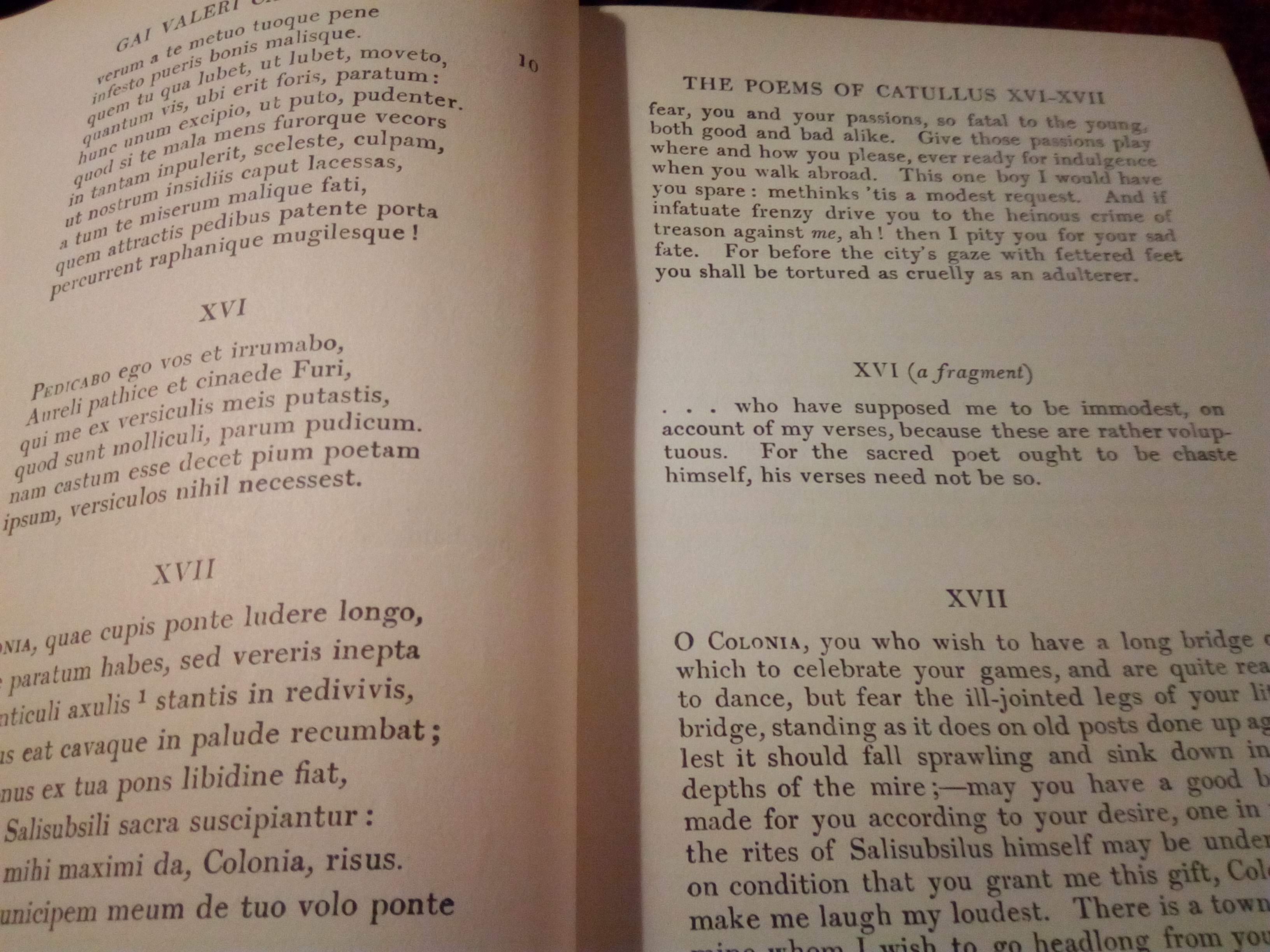
That’s one way to get around obscenity – just miss out the dodgy lines altogether, and present the rest as ‘a fragment’! I also rather liked this translator’s note, disclaiming responsibility for some of the most bowdlerised poems – it makes me wonder what arguments were going on behind the scenes…
I’ll leave you with the inimitable Virginia Woolf, who reviewed the Loeb Classical Library in 1917. She wrote, among other things, that ‘The Loeb Library, with its Greek or Latin on one side of the page and its English on the other, came as a gift of freedom… The existence of the amateur was recognised by the publication of this Library, and to a great extent made respectable…’, and finally, ‘we shall never be independent of our Loeb’. A hundred years later, she’s still right.
This week from around the Classical Internet
News
Huge statue at the Temple of Zeus – The Guardian
Mary Beard on Boris’ Latin – The Times
A tribute to Anton Powell – CUCD

Comfort Classics this week
Comfort Classics: Liz Webb on Thucydides
Comfort Classics: Alex Imrie on Dio Cassius
Comfort Classics: Tony Keen on Carry On Cleo
Comment and Opinion
Happiness is an activity – Classical Wisdom
Courage and reconciliation – What Would Cicero Do?
Edward Lear and the Rebus – A Don’s Life
Decolonising the Classics – The Spectator
How did ancient cities weather crises? [Greg Woolf] – Nature
No higher law – Classics at the Intersections
Truth in myth – Kiwi Hellenist
Poems as women – Rogue Classicism
Hipparchus and Philostratus – Georgy Kantor’s Blog
What would you preserve? – Society for Classical Studies

Podcasts, video and other media
Democracy Rises – Casting Through Ancient Greece
Greek naval warfare – The History of Ancient Greece Podcast
The Persians livestream, 25th July – Ekathimerini




 Classical Studies Support
Leave a reply to Steven Havelin Cancel reply