You may have noticed that I haven’t been around much this year. I used to post on this blog every week, but now I post very rarely. I used to be on all sorts of Classics-related committees, but early in the year I pulled out of most of those commitments. I disappeared for months from social media. I haven’t been taking an active role in Classics initiatives (like this month’s #ClassicsTober) that I helped set up. I’ve been a pretty rubbish mentor and friend too (sorry to all the people I haven’t answered or checked on!).
But what you probably don’t know is why.
If you’d like to know, then I suggest that this would be a good time to make yourself a coffee. This is going to be a long post – and I’m warning you now that I’ll have a favour to ask at the end! But don’t worry: it’s not a sad story, so it’s not insensitive to eat biscuits while you read.
Are you sitting comfortably? Then I’ll begin.
I’ve written on this blog before about my diagnosis of autism and my attempts to put neurodiversity on everyone’s checklist in Higher Education. But I haven’t really written much about my experiences as a parent, and that’s where this particular story begins.
When my son (let’s call him The Boy so that this won’t pop up when future girlfriends search for his name online!) was born in 2012, I knew immediately that raising him was going to be a challenge. So did everyone else in the hospital. I met a mother years later who’d been on the same maternity ward; she remembered me as the poor woman who had to pace the corridors all night with a newborn who wouldn’t stop screaming.
That didn’t change for what felt like a very long time. The Boy didn’t sleep at night for six years; and he lobbed many other challenges at me as he grew up. By the time he was two and a half he ate only three things, couldn’t leave the house because he was so frightened of strangers, screamed in panic if the TV was turned off (by this point my brain was pickled from a year of 24-hour children’s TV), couldn’t speak, and didn’t respond to his name. I did my work while he napped and looked after him when he was awake, so I mostly didn’t sleep at all. In my sleep-deprived Mickey-Mouse-Clubhouse fog, I didn’t have the faintest idea what to do next. I was just trying to make it through each day.
The health visitor showed up a few months late for The Boy’s two-year check-up, took one look at what I was dealing with, and called in the cavalry. The cavalry consisted of a paediatrician, the specialist health visitor, a community nursery nurse, the Preschool and Portage agency, Speech and Language, Occupational Therapy, Audiology, the specialist dental service, and probably a bunch of other people whose names and faces have been lost in the fog. At one point, I remember, we had fifteen people around a table, all talking about how to help The Boy. They were all tremendous. They didn’t have an agenda, and they weren’t waiting for a diagnosis. They just looked at what we needed and they made it happen.
As an example… we started by trying to get The Boy out of the house and accustomed to people. The team arranged for the local children’s centre to be completely cleared of people for a few hours every week (the receptionist was allowed to stay, but she had to hide when we came in). I would take The Boy there in his covered pushchair and let him roam around and investigate all the toys. At some point the community nursery nurse, Cheryl, would come in and start playing with toys at the far end of the building, completely ignoring The Boy.
It was a month before he could stand to be in the same building as Cheryl. It took six months for him to go over to her and see what she was doing. But after nine months The Boy and Cheryl had invented their own games and were laughing and playing together happily.
We built on that by introducing The Boy (very slowly!) to other kids, getting him a hearing test, doing an assessment for mobility problems, going through the formal process for an autism diagnosis, and setting up one-to-one support to enable him to go to nursery when he turned three. He still didn’t speak, didn’t sleep at night, and could only eat three things – but I wasn’t living in a blur of worry any more. I had a team. Everything was going to be ok.
And in the end it was.
Happy Endings…?
By the time The Boy left primary school he was doing great. He had loads of friends, was great at maths and geography, had developed an interest in football, and most importantly he was generally happy with his life. He’d been diagnosed with autism at the age of four, had grown out of needing one-to-one support by the time he was six, and by the age of ten he was so good with the littlest kids that he was given the job of looking after them over lunchtime.
It hadn’t been plain sailing by any means, for him or for me. Divorce tripped me up when The Boy was seven, with Covid coming hard on its heels. I was struggling to make ends meet; we were splashing along well below the poverty line. But I was grateful every day for the massive amounts of help we’d been given. None of it was private or paid for – in fact I hadn’t even had to ask for it. The services and the people were simply there and keen to help.
I hadn’t realised back then that we were the lucky ones.
Throughout The Boy’s time at primary school I watched the services he had relied on being cut down and scaled back for younger kids. The same wonderful support worker who had spent every morning giving The Boy one-to-one support at nursery was soon supporting a dozen children at the same time across several different nurseries; and a few years later she stopped appearing altogether. Every single support service was stretched to breaking point and beyond, and the school didn’t have any spare money to fill the gaps.
Health services were being cut down too. Our supportive paediatrician left and wasn’t replaced. There were waiting lists for all the services we’d just waltzed into, and those waiting lists were years long. There was no time – and no staff – for creative solutions to problems. Kids (including some in my own family) were falling through the cracks, and I was just watching it happen, because there was nothing I could do about it.
Then, a couple of years ago, I started to wonder – was there something I could do about it?
The Sequel
I knew I couldn’t go out and change the world by myself. I was just a cash-strapped mother in a small and dusty corner of North-East England – and on top of that I was a chronically shy autistic, so I would have been the world’s worst activist. But I did have some things going for me. I’d spent the last decade reading everything I could about autism, and learning from all the brilliant professionals around me. I’d invented strategy after strategy to help The Boy, and watched other people inventing things too. I had ideas coming out of my ears, 20 years’ experience in distance learning, and two Masters degrees in Education.
And I could write.
Together with my partner Tony – who’s a GP with a background in coding, and who also happens to be autistic – I started thinking about what we could do, using just the skills we had and the resources we could access, to provide parents with their own desperately-needed cavalry.
So that’s where I’ve been for the last year. I’ve been working evenings, weekends, and any other time I could scrounge, to write, design and develop a mobile app to teach and support parents of autistic kids. It’s been intense but satisfying, because it’s involved me revisiting every problem and every solution from the last decade, and weaving all of them into tips and explanations for other parents and families.
Our app is called ‘fraut’ (as a nod to how fraught a lot of parents are), and it’s now available to buy on Google Play for use on Android phones, tablets and Chromebooks. We’re working on the Apple version now, and that will hopefully be out in a few months.
I’m so thrilled that fraut exists in the world, because it’s probably the most important thing I’ve ever produced in my life. It’s packed full of everything we could think of that would help parents like me: workbooks, videos, diaries, fact sheets, autism-positive posters, suggestions for all kinds of situations, and explanations drawn from the amazing autistic people around us.
We’ve tried to keep the price low, at £9.49. We hate that we need to charge for fraut, but we’ve received no funding at all, and realistically we can’t keep going with developing materials and moving onto other platforms unless we recoup some of our costs. But we were determined to avoid a subscription model, which can be a trap for some neurodivergent people; and we didn’t feel right about trying to sell things to people with in-app adverts or affiliate links. So the £9.49 up-front cost covers all of our content, forever, along with access to lifetime updates. No hidden charges or tricks!
And now we come to that favour I mentioned before. The market for the fraut app is specifically the parents and families of young autistic children – so very few people reading this will be interested! But maybe there’s someone in your network who is. So I’d like to ask you to pass on information about fraut, if you feel comfortable about that, to anyone who might benefit from it. We don’t have a marketing budget (or in fact a budget at all!), so we’re relying entirely on word of mouth to get fraut known, trusted and noticed.
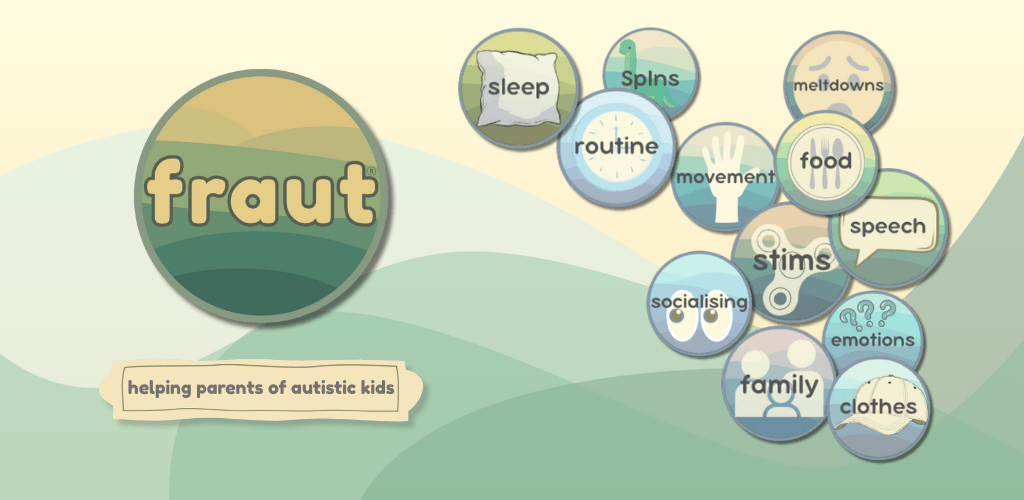
You can share our website, fraut.co.uk, where we post news, links, updates, free downloads and more. The app itself is on the Google Play store; and when the Apple version is released we’ll announce it on the website. We’re on Bluesky at @frautsupport.bsky.social, and when we’re brave enough we’ll move into other social media!
But even if you’re not in a position to share, I’d like to thank you for making it this far through a post that really has nothing at all to do with Classical Studies. You definitely deserve biscuits!



 Classical Studies Support
Leave a reply to Millie Withington Cancel reply