
The world is in a state of upheaval at the moment, and we’re all looking for things to make us feel less anxious. Maybe Classics can help.
Today’s interview is with Karis Williamson
Is there a source from the ancient world that you find yourself coming back to when you want to feel better?
Yes, Book One of Homer’s Iliad; the section in which Hephaestus and his mother Hera are depicted on Mount Olympus debating the pros and cons of arguing with Zeus!
When did you first come across the Iliad?
I came across it during my first Classics module as part of my O.U. degree; it was also the subject of my first Classics assignment.
Can you tell me a bit about this passage and its context?
This passage is taken from Book One of Homer’s epic poem The Iliad, possibly written down in the 8th century BCE (although elements of the poem may have been composed and performed orally earlier than this). In the immediate context of the poem, Hera has just confronted Zeus for promising Thetis that he will honour her son Achilles by saving him. After this exchange, Hera’s son Hephaestus reminds her of the dangers of challenging Zeus and refers to his own personal experience when he defended Hera, after which he was ‘hurled from the divine threshold’ and returned to Olympus as a disabled deity in the Homeric version of the Hephaestus myth. Poignantly, elsewhere, Homer also depicts Hera throwing Hephaestus from Mount Olympus when he was born lame or ‘of shrivelled foot’ as she felt disgraced and ashamed of him because of his physical deformity.

What is it about this passage that appeals to you most?
I feel a strong connection to Hephaestus as he is one of the few ancient representations of disability and its relationship with society, although it’s uncertain that the actual concept of disability existed in Homeric times (although similar words for it did). He also seems to possess more human qualities than the other Olympian gods such as empathy and self-sacrifice. I wonder if this scene is a deliberate social comment by Homer regarding attitudes towards people with physical differences; Homer himself was known as ‘the blind bard’ so he may have experienced some of the social inequalities that Hephaestus has to endure, despite his Olympian status.
The part of this scene which encapsulates all of this for me is when, after warning Hera of the consequences of her actions, Hephaestus has to serve food and drink to all of the other Olympians; the gods then proceed to mock Hephaestus’ disability, laughing and imitating his limp. Homer does not depict Hera as defending him; she apparently chooses to remain silent. This piece also illustrates both Hephaestus and Hera’s non-reciprocal relationship and the irony that Hera chooses to challenge Zeus on her own behalf and on the behalf of her favourites such as Odysseus but she does not defend her own son, possibly also due to his inferior social status amongst the Olympian gods. For me, this represents a microcosm of modern society; most people with differences will experience ‘the Hephaestus moment’ when those they thought they knew, or who should have known better, just look the other way. The good news is that for those of us who do experience this, it can be like a Spartan training; it’ll make you stronger and armour you like a Greek hero. I like to think that I’m wearing Hephaestus-designed armour; I will never give up – and, guess what, Hephaestus gets a partner called ‘Kharis’!
The best thing about this passage is that Hephaestus shows it is possible to be heroic and to confound social expectations of disability. I also wonder if Homer was questioning the Greek concept of what constitutes beauty, as Hephaestus (who Hera claims is very physically unattractive) is, paradoxically, capable of creating such fantastically beautiful artistry embodying the three Greek values of beauty, intelligence and arête. I feel that Hephaestus’ characterisation reflects that he is more beautiful than all the other Olympians.
And finally… what do you do, outside of Classics, to cheer yourself up?
Normally, I would be travelling, going to concerts and theatres etc. but lately, I have been catching up with all the books I meant to read, the films I meant to watch and the plays being streamed online, I’ve also been writing poetry and film-scripts. Most recently, I’ve been setting some of my poems to film.
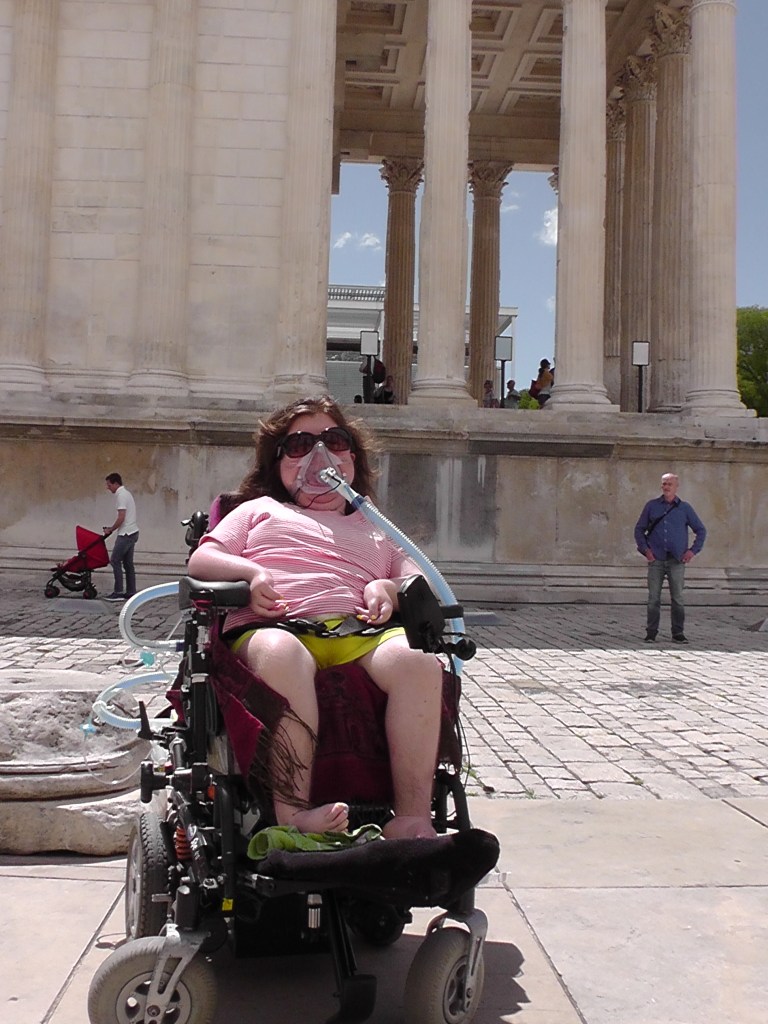
Karis Williamson is a twenty-one year old disability campaigner, a member of ‘Trailblazers’ and an Ambassador for ‘Euan’s Guide’; she has just finished her O.U. Open Degree studying Creative Writing and The Classics. Currently, she is challenging issues around shielding; she feels it’s failing disabled people (you can read her thoughts on Feeling Locked Out in Euan’s Guide’s ‘Voices of Covid’) She is also about to take part in a digital project with the theatre company ‘Birds of Paradise’ and she is going to build up her first poetry collection which will have a Classics throughline. Author and poet Ben Okri has read and requested one of her poems for his next poetry compilation.
Catch up with all the Comfort Classics interviews here.



 Classical Studies Support
Leave a reply to Karis Williamson Cancel reply