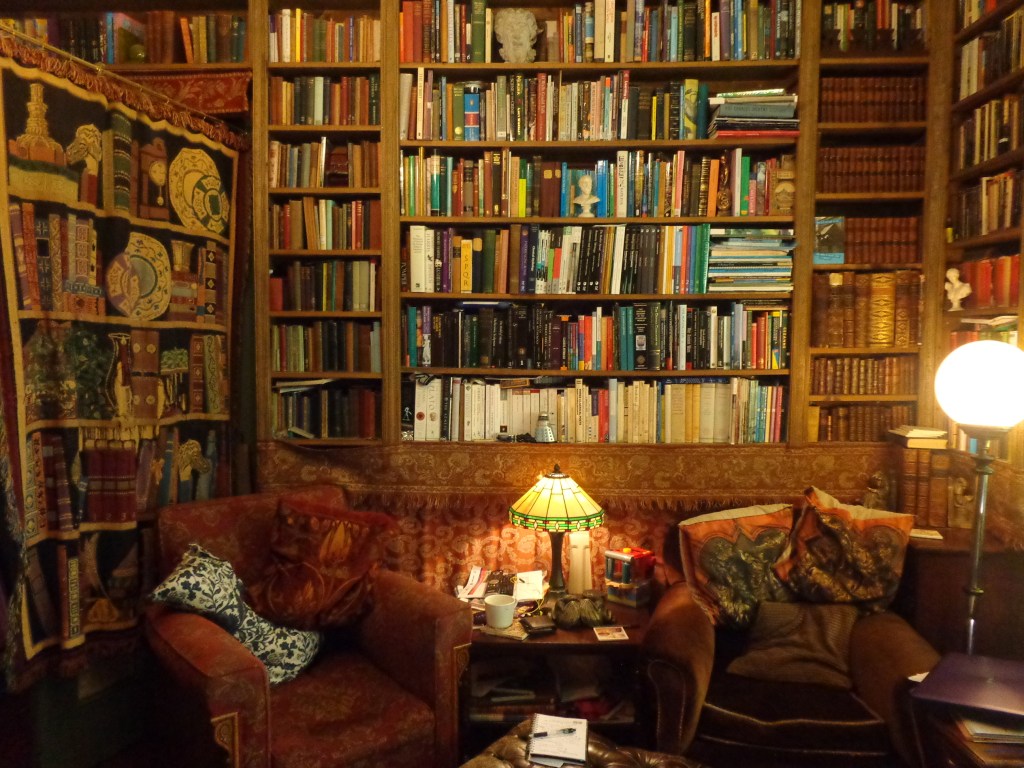

One of many things which fascinate me, as a bibliophile, is the space where a book ought to be. If you’re a classicist you will have spotted some of these conspicuous spaces: at the end of Tacitus’ Annals where the second half of Book 16 ought to be, perhaps, or the missing books of Livy’s history which reputedly led Augustus to describe him as a Pompeian. These gaps are not completely empty, because the books have left impressions behind, in summaries and comments and quotations by later writers. Using other sources we can deduce the size of the gap, and see a ghost of its original occupant.
But what of the books which haven’t left a shadow behind? If there existed, somewhere, a library of all the great works which have been lost, what would it have on its shelves?
Let me take you, then, on a tour of my very own Impossible Library, containing all of the books that I wish I could see. In it I’ve included books which once existed and books which were rumoured to have existed, and some books that never were. It’s likely that none of these books will ever be found – but who knows…?

My Impossible Library starts with the Sibylline books, the Libri Fatales: all nine volumes, of course, including the six which were burned by the Sibyl when Tarquinius Superbus refused to buy them. The remaining three were so powerful that they were kept under constant guard by ten men, lest they change the world. Naturally they deserve a place in my bookcase.
Also in my library is the full text of all the works attributed to Homer, among them the comic Margites, about a man who ‘knew many things, but he knew them badly’, as well as the five books of the Nostoi, the sequel to the Iliad.
I have Ovid’s only play, Medea, and Augustus’ memoirs, De Vita Sua. I have all of Caesar’s works, and Suetonius’ lost massive history of Rome. I have the early Roman playwrights and annalists, from Ennius to Pictor, and the missing works of the Greek lyric poets. And of course my bookshelves hold the lost bits of Tacitus’ Annals.
Sadly my Impossible Library only exists in my imagination, and in a painting on the wall of my real library. But it’s a reminder that all the works we study, and all the evidence we use, give only a fragment of the full picture. My library may be impossible, but it’s also important, as a reminder of how much we don’t know.
Cora Beth Knowles




 Classical Studies Support
Leave a comment