

It’s rare for me to go somewhere to give a talk.
It’s not that I don’t want to. It’s just that my routine-driven autistic brain isn’t happy with having to take on the challenge of travel and a new place, combined with the challenge of speaking in front of an audience.
But sometimes I try to push myself out of my comfort zone. So next week I’m off to Oxford.
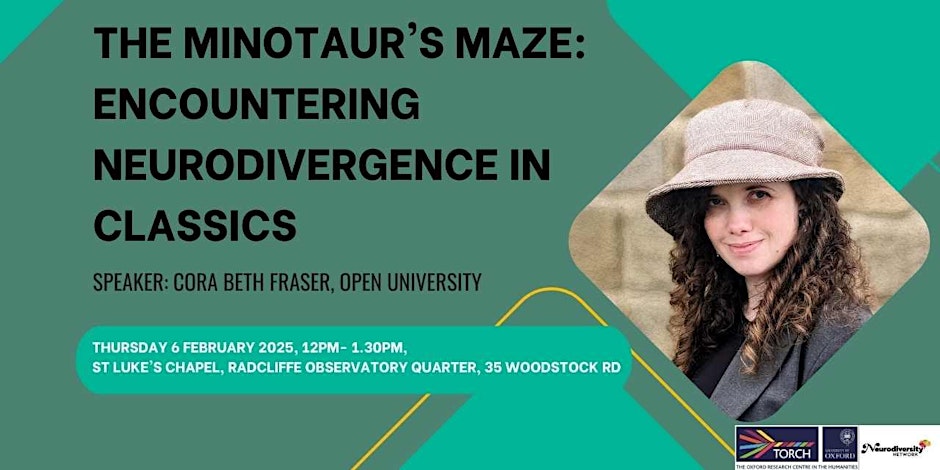
I received an invitation I couldn’t pass up, to speak about neurodiversity and Classics to Oxford’s Neurodiversity Network. I’ve followed the work of the Network for a while: they’ve only recently launched, and they’re already doing good things. But just the fact that the group exists is, I think, important.
Ancient History
If there had been an organisation like this around 25 years ago, I might have ended up going to Oxford myself. As it was, I came pretty close. I sailed through the entrance exams (I love a test, and those ones were fun!), but the interviews were a disaster. I just froze up.
Oh, and then I panicked and ran away before the last interview. That may not have helped my chances!
It wasn’t Oxford’s fault. There wasn’t much understanding of neurodiversity back then, and certainly nobody was inclined to accommodate the needs of one socially awkward teen who was easily overwhelmed. It wasn’t my fault either. I didn’t even realise I was autistic, because back then we all thought of autism as being like Rain Man, and that definitely wasn’t me.
The world just wasn’t set up to help people like me succeed.
So I think it’s wonderful that today’s autistic kids have more of a chance, thanks to increased understanding, improved diagnosis and the awareness-raising efforts of organisations like Oxford’s Neurodiversity Network.
Anti-EDI
There’s a lot of pushback these days against ‘wokeness’ and Equality, Diversity and Inclusion initiatives. In some ways I understand that. Anyone who’s had to write an EDI statement lately as part of a job application will be well aware that a lot of these commitments are performative and false. There’s a great deal of empty rhetoric around, as people jump on bandwagons for their own advantage – and that annoys me too.
However, there’s also real, constructive work out there which is having an effect.
Most important, perhaps, is the fact that it’s having an effect across society.
When I talk about autism, people often point out that there have always been weird, obsessive, socially awkward people in academia (and particularly in Classics!), long before autism was a ‘thing’. So why would we need to improve access for autistic people when they’ve been finding their way in anyway?
My answer to that is simple: most of those people were wealthy.
If you come from a wealthy family, or even the aristocracy, it’s always been much easier to get away with eccentricity. Nobody really takes much notice if somebody from that kind of background is a little odd. They’re given places at elite institutions because it’s quickly recognised that they can succeed there.
However, if you’re not from an elite background your quirks tend to count against you. You’re already working very hard to prove your abilities; but you also have to show that you will fit in. For an autistic person that’s not impossible: but it is a very long shot indeed.
Looking to the Future
For a long time that situation didn’t change: but just in the last few years I’ve seen some movement, as talk of neurodiversity becomes mainstream (although as I type, WordPress still doesn’t recognise the word ‘neurodiversity’). Granted, the talk isn’t all positive; but there’s an increasing awareness that a portion of the population simply think in different ways. Rather excitingly, this is starting to be seen as a positive in some contexts.
This matters a lot to me, for a very practical reason. It matters because my son is 13 and autistic. I’m trying to open doors for him that were shut for me, and I’m on a timescale to do it.
I don’t think he’ll necessarily choose to go through those doors. He doesn’t feel the same pull towards history and culture and Oxbridge (and libraries!) that I did. He’ll probably go off and do something completely different when he’s 18. But that’s beside the point.
The point is that although lots of things in the world seem to be getting steadily worse, some things are getting better; and I would very much like to be part of that change.
So I’m excited to be talking about neurodiversity on Thursday – and if you’re in the Oxford vicinity and fancy coming to a free talk, I’d be delighted to see you!
Here’s the link to the Booking page. Do come, if you can!





 Classical Studies Support
Leave a comment