
I’ve known for a while that the Working Classicists group was working on something interesting. I knew because I was asked to write a small section of it – and I was also commissioned to create an illustrated poster to go with it.
That was great fun to do!
But I didn’t know the full scope of the project until the announcement was made on social media last week…
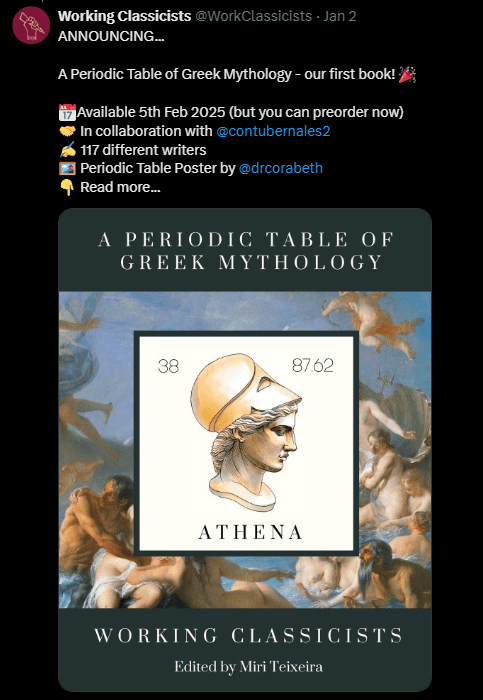
So this week I caught up with the founders of Working Classicists, George Connor and Miri Teixeira, to find out more about their new book, due for release in early February through Contubernales Books.
Where did the idea for a myth “periodic table” come from?
George made a periodic table of Greek Mythology for use in his classroom eight years ago. Each element is laminated and stuck to the wall with blu-tac so that it can be taken off and put back. For example, you can ask pupils to “find the character who was abandoned by Theseus” and they have to have the preknowledge of Ariadne to complete the task. Sometimes, pupils are asked to select a type of character from one of the categories to form the basis of a piece of solo research, and so on.
There are loads of uses for a periodic table like this, and we’re always happy to share the original files with fellow teachers if they get in touch (george@workingclassicists.com).
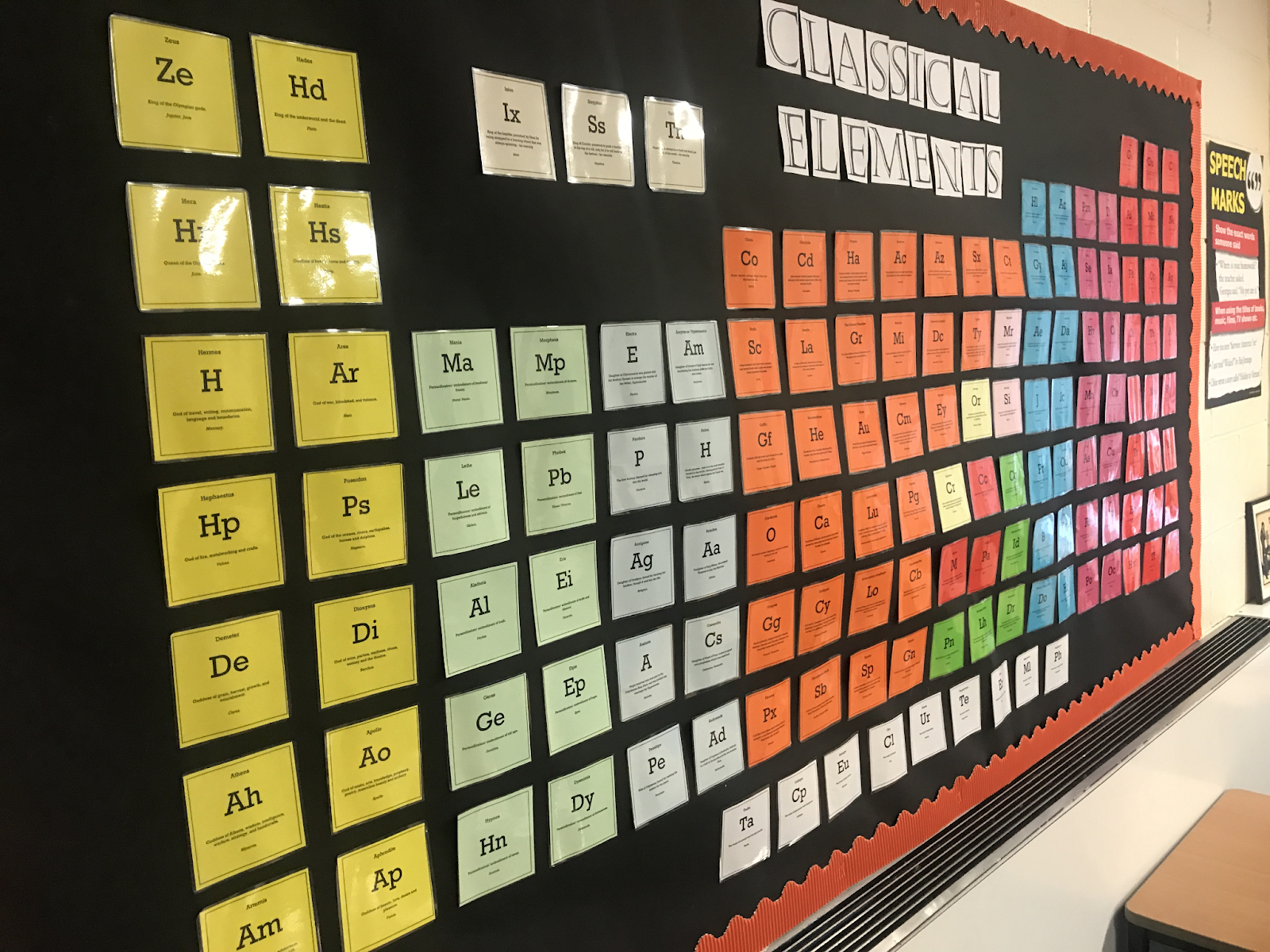
It’s a semi-common way to remember large quantities of information. Some colleagues have come up with their own versions, and it’s certainly not unique to us, but it’s been such a valuable resource it was always in the back of our minds to make a more polished version for Working Classicists along the line.
So when Contubernales approached us, the periodic table was literally our first thought.
To begin with, we thought about writing it ourselves but, bearing in mind the collaborative nature of the Working Classicists project, we quickly realised that the table lent itself perfectly to having loads of different writers and perspectives. Why keep the credits to just the two of us when we could get more than a hundred people published?
We sat in a cafe with our then-volunteer Jaqueline and drafted up a document pretty much right away. It all fell into place from there.

How did you find so many people willing to contribute an entry to the book?
It was a three-pronged approach. Firstly, we contacted people who had written for us before, those who contributed to our zine, and who had identified as Working Class and implied they wished to work with us again.
Secondly, we asked for recommendations from these people, forming a sort of “advisory panel” so that we didn’t just recruit our friends or people we already knew about. This was a particularly useful technique and pulled in people from all over the world. We’re so grateful that even in the very early stages people were so keen and willing to help us put this project together in line with our ethos. Teachers recommended students, colleagues recommended each other, authors recommended other authors, and many lecturers recommended early career academics.
Finally, once we had just a few spaces left to fill, we put out a call on social media for writers and people responded. We are lucky to have quite an active online community. It’s not just a passive thing where people have a look and scroll on – they get in touch, they pitch ideas, they share their successes and failures. At heart, this is why we managed to get so many writers together in such a short space of time.
It must have taken a huge amount of work to pull the book together – but you’ve also mentioned that you did a lot to make the writing process more accessible to your contributors. Why did you think that was so important?
If we had to distil what we do down to a single concept… it’s access. In every sense, we have to make the discipline open to everyone.
This means providing the right conditions for everyone to contribute, by offering proofreading, offering editing, offering flexible deadlines, offering all the support that each writer needed to make sure they were happy with their final contribution.
On several occasions, people emailed us and pre-emptively tried to pull out of the project with apologies for things like neurodivergence causing late submission or the quality of their written English not holding up (in their eyes). But we curbed these attempts and talked it through with the authors, who very much still wanted to be on board. They just felt they would be kicked off for struggling. As talented writers, there is no way we wanted to lose them, so a little flexibility or a more hands-on approach makes sense.
We can only hope that this becomes more normalised.
We’ve both been through academia and we know that practical support and encouragement is not always a given. We also know from talking to people via Working Classicists that accessibility remains enormously uneven in universities and schools. It shatters people’s confidence when really they should be uplifted, given the accessible tools to do their thing, and praised for what is genuinely brilliant work.
What we really wanted to do was to produce a book that said it is entirely possible for everyone to contribute to a publication like this and that – to quote our current motto – there is a place for everyone at the feast.
If you could change one thing about Classics in the UK, what would it be?
We’d integrate private schools into the state sector. That may be a bit broader than the question intended but the split between private education and state education is damaging for the whole of society, not just for Classics. However, when it comes to Classics, the disparity of provision between the two is really stark.
There is absolutely no good reason why someone from a well-off economic background should be offered Classics at school, but someone from a poorer economic background should not.
Oh, and high percentage quotas for state school pupils at university Classics courses.
Sorry if that’s a bit weighty!
We’d also love to see some of the people we have platformed start to get public-facing gigs in broadcasting and so on. That would be cool.
The book is a tremendous achievement and you deserve a break! But what’s next for Working Classicists?
There are ALWAYS projects.
We’re currently restructuring our Zine payment scheme so we can pay our writers a little more, so we’ll be resuming publications there soon. We’re very proud that the Zine is our meat and drink – every couple of weeks or so another writer gets a platform to write about whatever they want and we can pay them for it.
For an organisation with such small resources, that’s the thing we are most proud of.
However, we’re putting the finishing touches to a textbook for National 5 Classical Studies which is going to be available for free on our website. There hasn’t been a new Scotland-specific Classics school textbook in fifty years, so that’s a bit overdue. The hope is that schools will be more likely to give the course a go if there’s some sort of text to refer to, and the upward trend in Classical Studies in Scottish state schools can go even further.
We also have some smaller booklets aimed at younger Classicists on the way. Hopefully, one of those will emerge every couple of months this year.
Nominations for this year’s Working Classicists Awards will open around February/ March. It’s always a high point in the year to hear all the great things that people are doing in the community.
Hopefully, we’ll be running a panel at this year’s Classical Association Conference in St Andrews. We have papers prepared around accessibility, and it’s the kind of content we feel strongly that universities need to hear.
There are a few other things bubbling under the surface, but we are also going to be a bit more serious about how much energy we can realistically put into Working Classicists. We both have full-on full-time jobs, and we have to put some lines around how much we do.
We love what we do, but we have to be well to keep doing it!
In personal news George’s metal band, Ostraka, will be playing its first gigs this year, and Miri will be continuing to review and write about video games whenever possible. And finishing with the best news: we got engaged last year, so we’ll be planning and saving and getting excited about that. We’re extremely lucky to have found one another, and it’s going to be a beautiful thing to be married to something other than our work!
Aside from that, the diary is pretty empty (haha)!
Congratulations, both – on the book, the upcoming wedding, and all the other exciting plans!
If you’d like to read more about the Working Classicists book, there are some important statistics on the Working Classicists website.
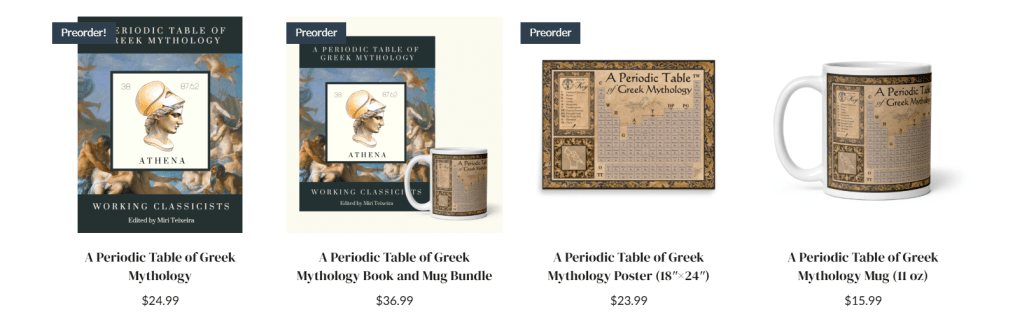
You can pre-order the book directly from Contubernales Books (or from Amazon). And Contubernales are also selling mugs and posters of the design I helped create – so I might treat myself to one of those!
 Classical Studies Support
Leave a comment